P7.0 / ONE SELECTED CONTROL MODEL
Launch harder.
Keep the peak.
Stop sooner.
Bring the drive, airflow, brake capacity and finite energy supply into one controlled sequence.
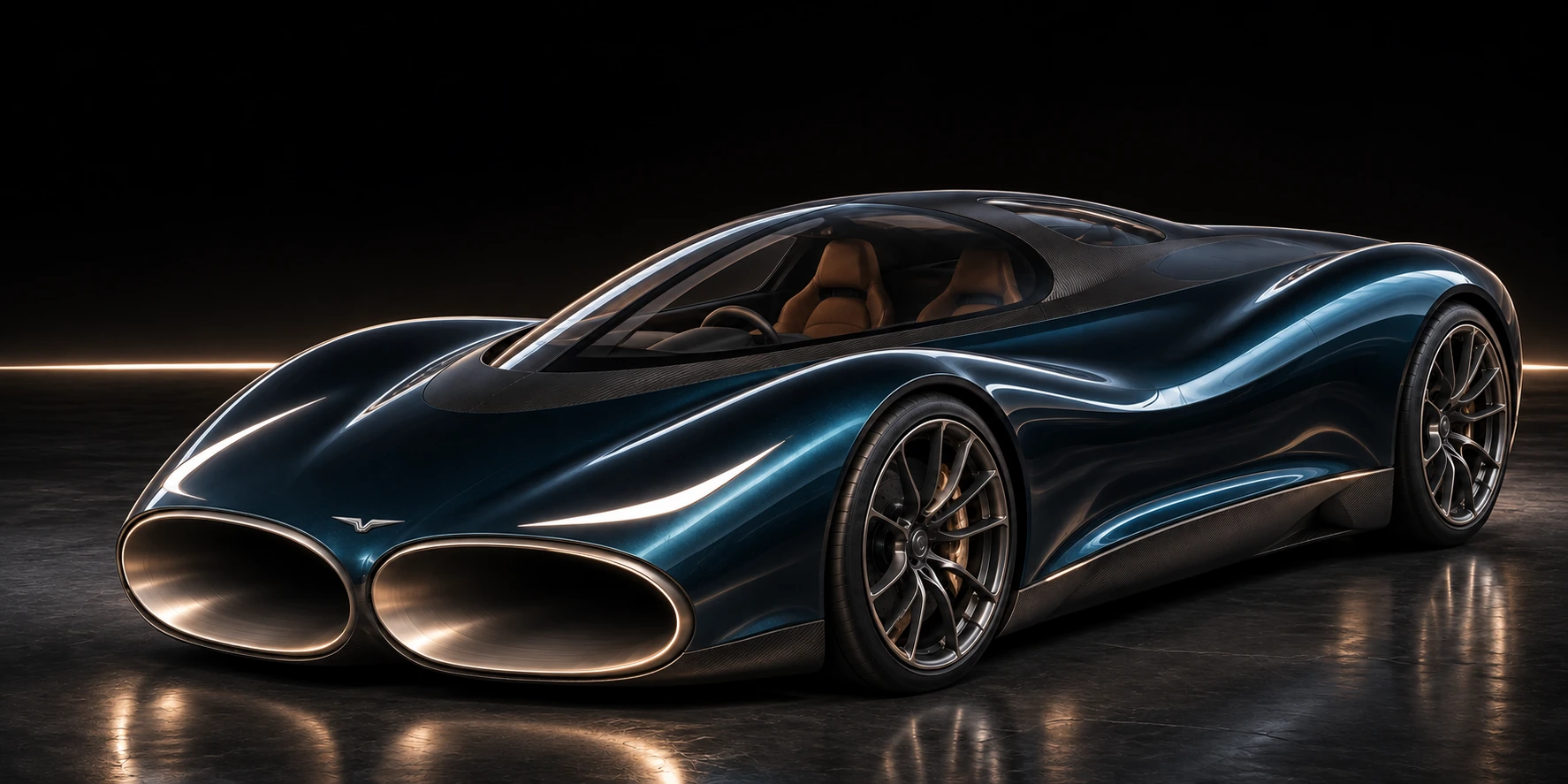
Physical measurements: 0
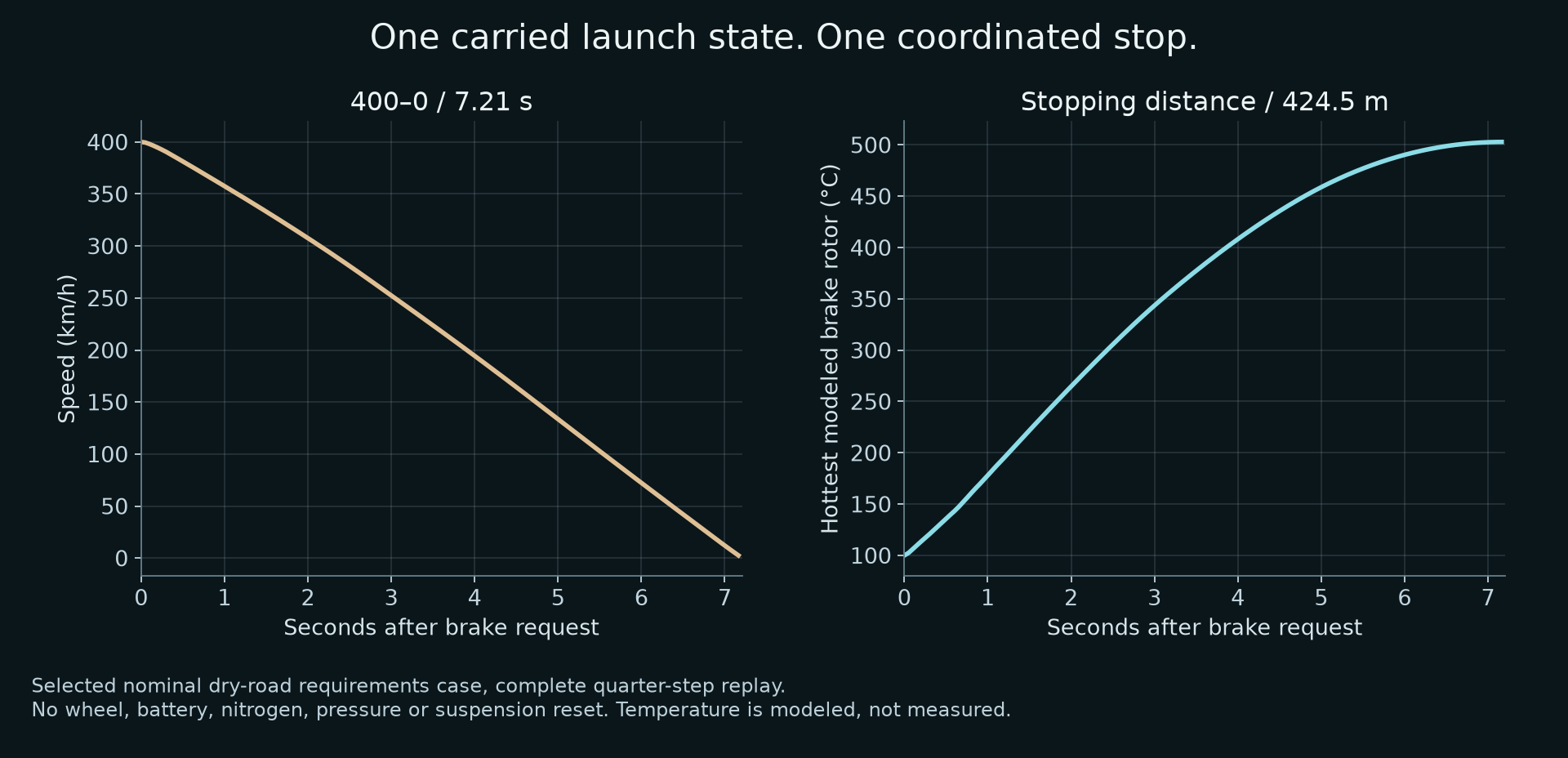
Nominal dry-road requirements simulation. The 400–0 stop takes 7.21 s. Immediate stopping and the later speed event branch from the same saved launch; neither receives fresh battery or nitrogen at 400 km/h.
THE SELECTED CONFIGURATION
Use the capacity.
Coordinate the limits.
The brake allocator now follows the capacity already declared in the build. Hydraulic pressure, grip, thermal limits, pump power and directional reserves remain in the account.
Both drive reserves, revised component positions and actual airflow force arms enter the complete layout. The changed exhaust route adds mass and paid pressure work.
The source ratio stays fixed at 3.09. Delayed conventional-torque protection operates inside the unchanged 12,000 rpm motor ceiling.
Conventional power300+-derived wheel-power assumption; no engine selected
Electrical tractionTwo finite source-derived drive envelopes
RatioFixed 3.09
Wet mass3,521.4 kg
Battery216-series / 18-parallel P50B cells
PreparationFuel-paid warm-up + electrical floor preparation
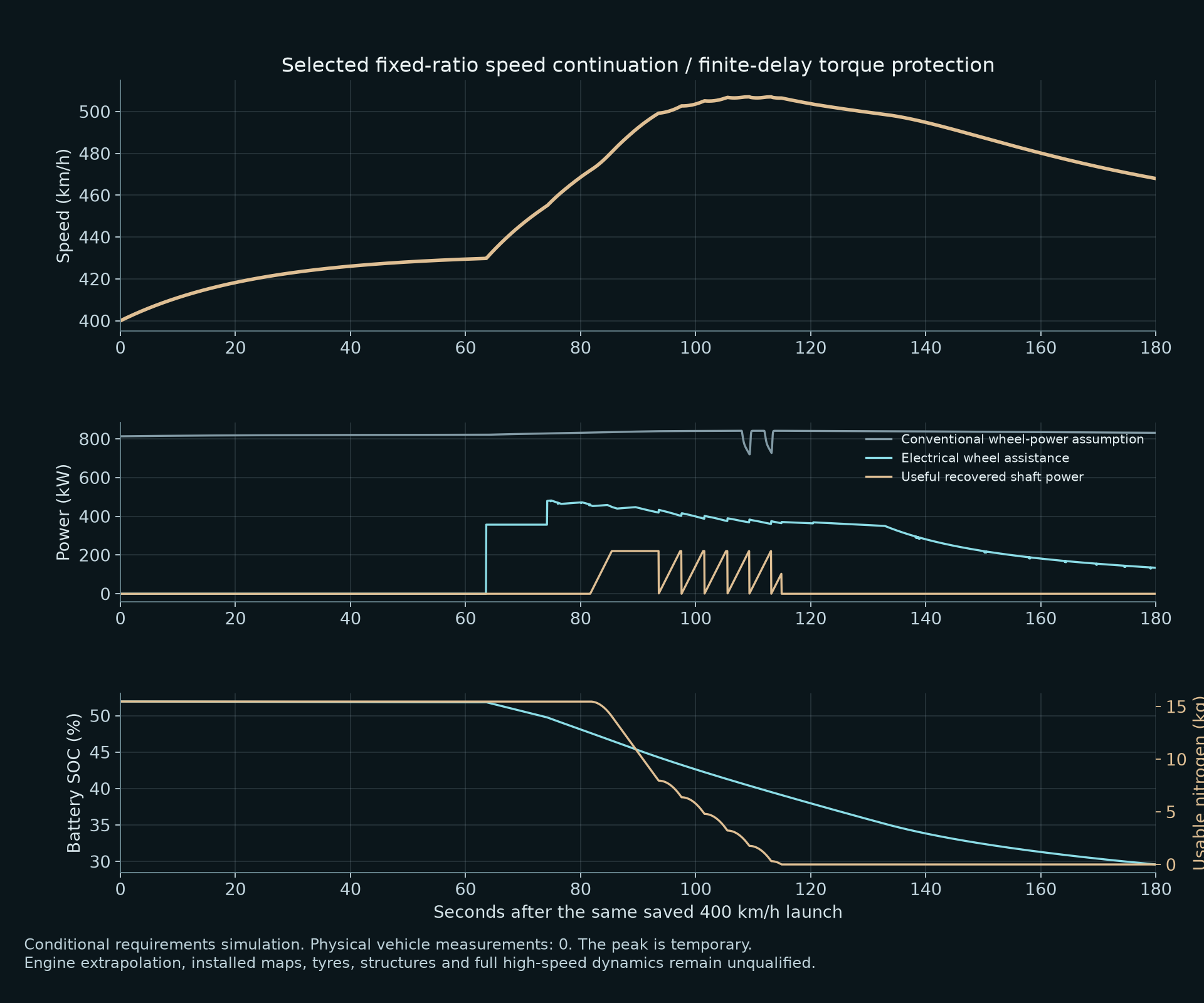
REPLAY THE SAVED SPEED EVENT
One launch.
Carry the stores forward.
Speed
Electrical wheel work rate
Useful recovered shaft power
Usable nitrogen remaining
Numerical replay at six times real time. The assisted peak is temporary. Six-minute fuel-paid warm-up and six-second floor preparation are counted before the timed launch.
THE SAME LAUNCH / IMMEDIATE STOP
Braking stays
in the same account.
Wheel recovery, friction braking, upper outlets and the powered pressure floor act together. The selected stop starts from the complete saved launch state.
THE EXACT PUBLISHED REFERENCE
Chiron Super Sport 300+.
The reference is Bugatti’s published 300+ specification sheet. The 2017 1,500 PS Chiron run remains an earlier reference in the documentation.
| Metric | CryoPulse / conditional model | 300+ / published specification |
|---|---|---|
| 0–100 km/h | 2.06 s | 2.4 s |
| 0–200 km/h | 5.58 s | 5.8 s |
| 0–300 km/h | 12.01 s | 12.1 s |
| 0–400 km/h | 24.32 s | 28.6 s |
| 400–0 distance | 424.5 m | 520 m |
| 0–400–0 time | 31.53 s | 39.2 s |
The model uses an aggregate wheel-power curve fitted to 300+ specifications under a 1,177 kW conventional-rating assumption. No engine has been selected. Battery and recovered assistance add propulsion. Actual engine, tyre, drivetrain and thermal maps and common measured road conditions have not been established; this is not a matched Bugatti road test.
Open Bugatti’s exact specification ↗CONTROL AND NUMERICAL REQUIREMENTS
Repeat the run.
Challenge the controller.
Three time steps.
The complete launch, stop and speed event repeat at nominal, half and quarter steps. Quarter-step figures supply the headline.
23 road and degraded-mode cases.
The same controller is tested with altered grip, gusts, port/motor faults, hot brakes, floor-motor supply loss and increased seal leakage.
3 speed-sensor cases.
Bias and slower observation/torque response are checked against the actual unchanged 12,000 rpm ceiling.
Geometry and access.
Both drive reserves, component clearances, protected passages, wheel travel and opening doors pass their declared geometry checks.
These are sampled requirements simulations. They do not establish physical safety, certification, failure probability or full high-speed stability.
THE BODY-INTEGRATED LAYOUT
Keep the roof clear.
Keep the doors usable.
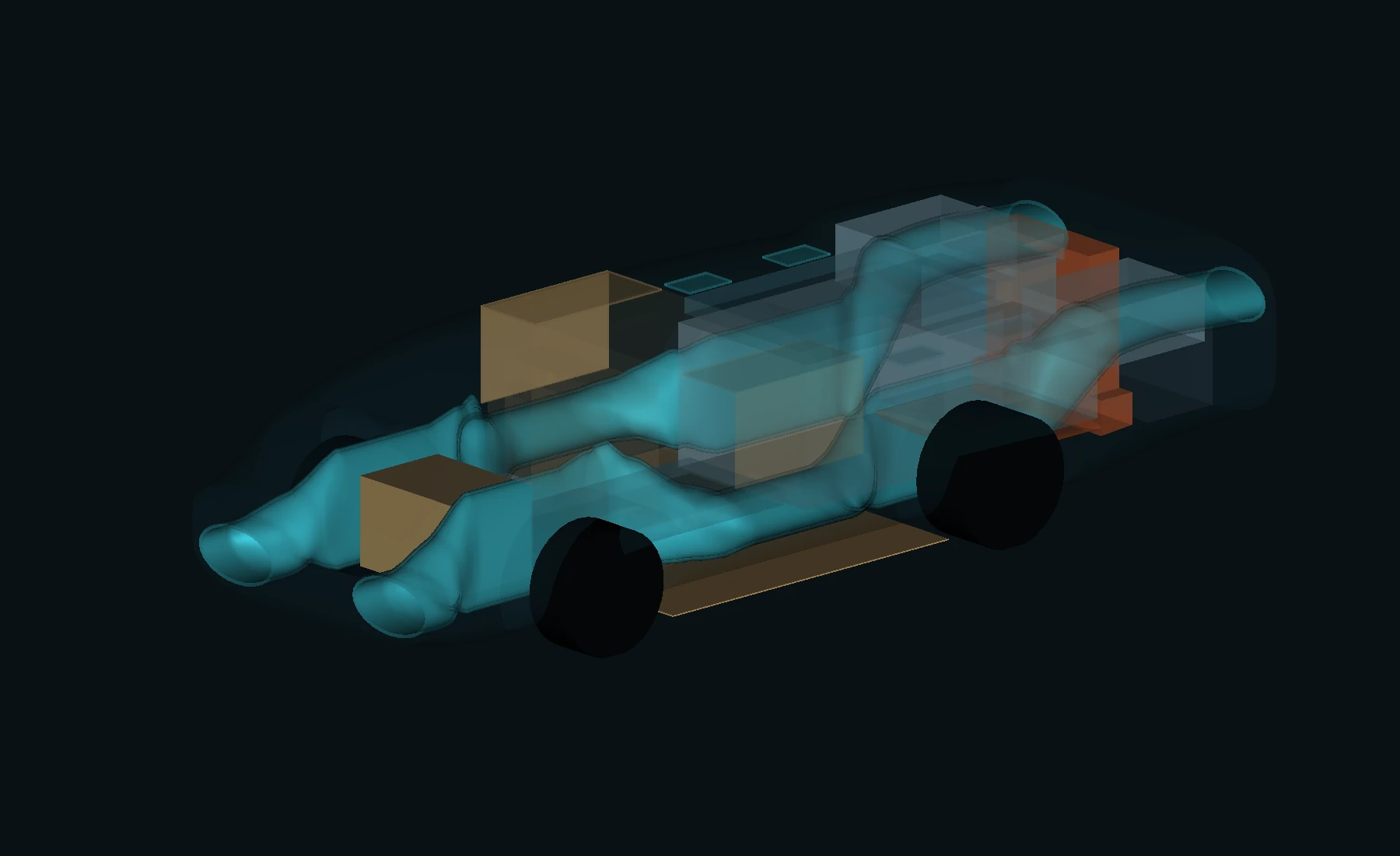
Space reserves and motion envelopes are shown. Supplier interfaces, installed duty, mounts, pressure hardware, crash structure and occupant qualification still need detailed engineering.
THE NEXT EVIDENCE
From requirements
to measured hardware.
Exterior drag area of 0.65 m² and duct K=1.5 remain unqualified. New flow grids have not earned a converged map. The engine curve above 400 km/h is extrapolated. Tyres, installed machinery, pressure systems and complete structures require independent engineering and physical tests.
The speed continuation is scalar; it cannot establish full high-speed stability. Further functional-safety, common-cause power-loss, structural and crash work remains. This is an unbuilt research concept.
OPEN THE WORK
The selected result.
The complete development record.
Download the model and development dossier ↗SHA256: 9dbf88e6cb66e16796b5705bf6701578467d7bf5d221b50221df4f509527f02e
Selected configuration, geometry and every reported gate ↗
Methods, controlled comparisons, rejected runs and numerical corrections are retained in the source dossier. No supplier endorsement or physical production-car record is claimed.