Earlier P4.1: 1.98 s
P4.2 / THE INTEGRATED DIGITAL PROTOTYPE
Less weight.
More useful work.
A broader pressure floor. A smaller, lower-resistance pack. Power routed around the motor’s torque limit. Four main results improve in the same launch and stop.
Conditional theoretical results · Physical measurements: 0
Earlier P4.1: 26.29 s
Earlier P4.1: 445.5 m
Earlier P4.1: 33.77 s
One selected build. One continuous event. Same fitted engine curve and tyre law. The same 10 MJ chemical, 8 MJ DC exchange and 6 kg initial nitrogen budgets. The new 16 mΩ cell-resistance ceiling and hardware maps are targets for qualification.
01 / THE PRESSURE FOOTPRINT
Use more area.
Keep the seal compact.
The deck is shorter and wider. Effective pressure area rises 24.9% while the external seal perimeter rises 4.3%. Leakage, compression work and fan power are recalculated together.
Illustrative routing with saved pressure-flow solutions. These are not CFD streamlines.
Floor load
Fan electricity
Motor speed
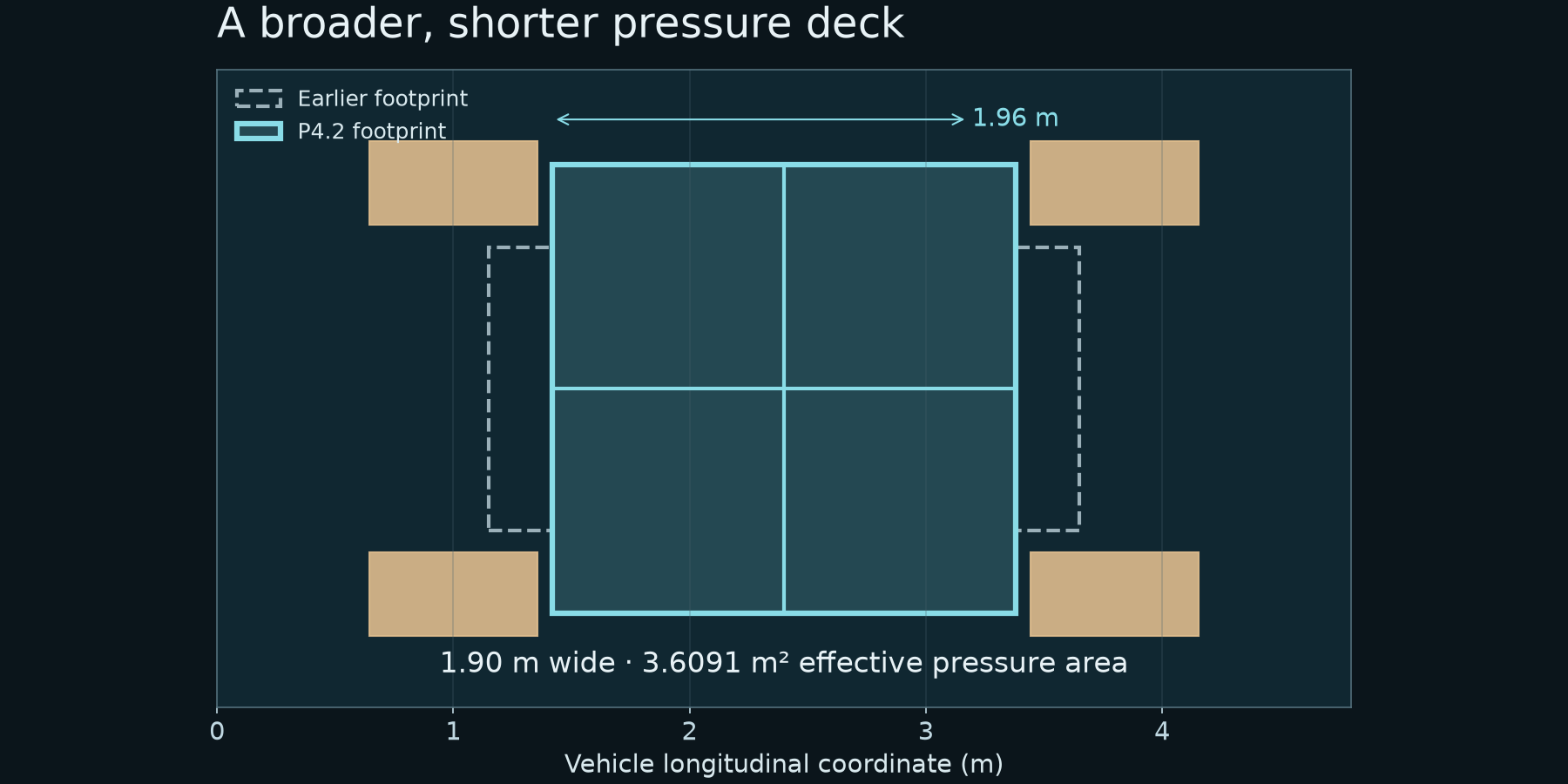
Conservative longitudinal separation across 1,782 sampled wheel poses: minimum 36.0 mm, including a 5 mm radial growth/assembly allowance. Whole-vehicle packaging remains incomplete.
02 / EVERY PART PAYS ITS COST
46.4 kg lighter.
With a fuller drive allowance.
Remove unsupported weight.
Remove 60 kg of active-camber hardware and the 4 kg extended vent mechanism. Ordinary geometry retains the same tyre law; no new grip bonus is claimed.
Combine the blower drive.
One motor drives three multistage cartridges. The 80 kg assembly budget contains 69.5 kg of dimensioned parts and allowances, leaving 10.5 kg margin. The pressure-flow map still needs a rig test.
Count the full electrical path.
The drive allowance rises from 18 to 125 kg. Torque, speed, gear loss and rotor inertia are included. A 216s9p pack replaces 216s11p, with a 16 mΩ resistance acceptance target.
03 / TIMING THE COLD
The same inventory.
A better moment to use it.
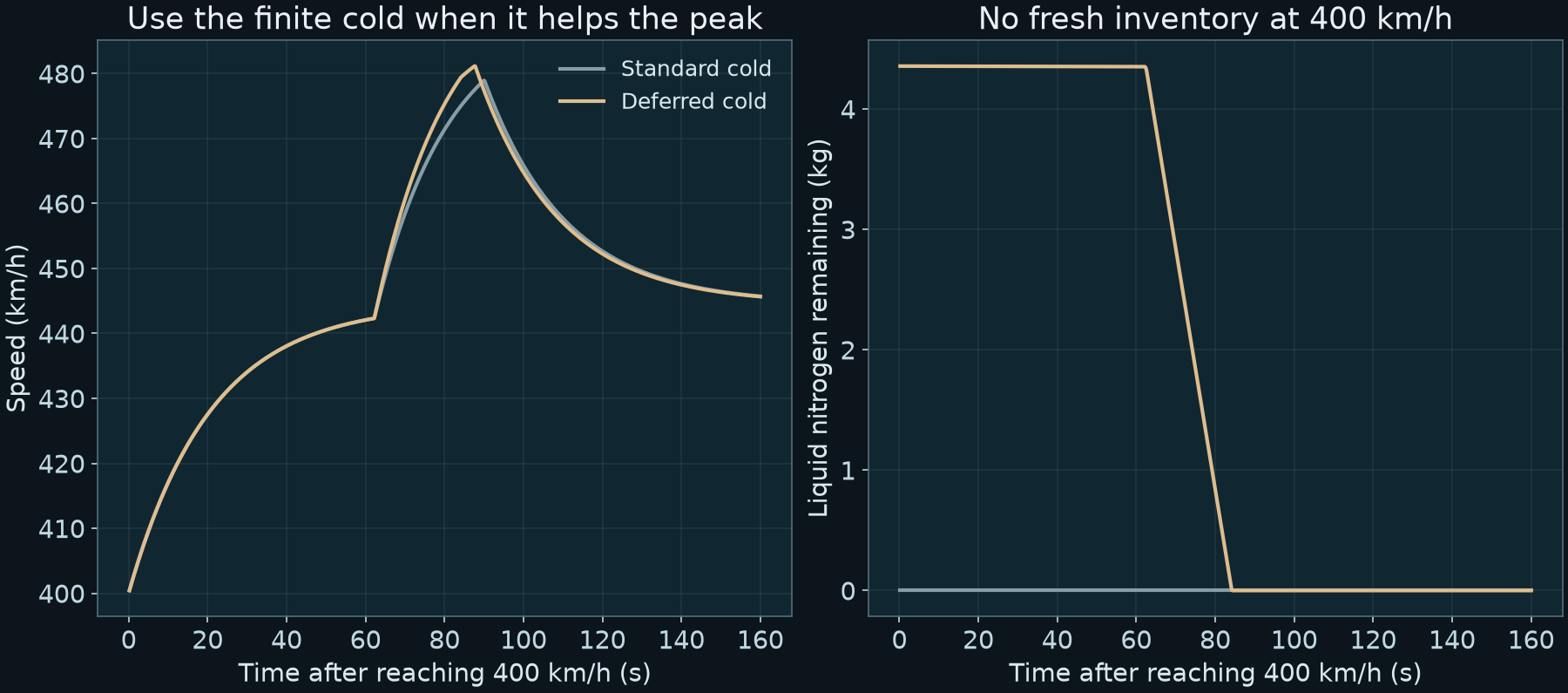
In a separate speed mode, hold the nitrogen flow during the slower boost-off launch. Engine exhaust heats the same finite metal mass. Release the cold for the late electrical pulse.
481.2 km/h
Calculated temporary peak. This mode takes 42.96 s to reach 400 km/h. It cannot be paired with the fastest sprint time.
With standard cold dispatch: 479.0 km/h.
With deferred dispatch: 481.2 km/h.
There is no store reset at 400 km/h. Wheel inertia, control demand, nitrogen use and the engine-derived heat account continue through the event.
Scalar power-balance screen. The drag target, engine extrapolation, installed winding map, tyres and stability remain unqualified. A temporary peak is different from a sustainable top speed.
04 / CORRECTION → RETEST
Fix the cause.
Rerun the car.
Power is not torque.
The old peak-power ceiling did not establish low-speed motor torque. The new model imposes separate catalogue ceilings and routes spare electricity to airflow.
A lighter motor needs a feasible start.
The common blower is preconditioned over 8 seconds. Rotor work, airflow draw, standby and nitrogen boiloff are paid before the timed launch.
Cold preparation was incomplete.
The cold wetted-metal allowance rises from 2 to 4 kg within the existing dry budget. Its additional preparation boiloff comes from the same six-kilogram supply.
What the computational checks establish
Nine standard road/fault cases and 18 additional sampled cases pass the stated stopping, trajectory and travel gates. Halving the timestep changes the stop by 0.049 m. These are numerical checks, not a measured failure probability or vehicle qualification.
- continuous launch and stop
- nine standard cases
- eighteen additional sampled cases
- all mechanical electrical ledgers
- same finite energy windows
- pack current voltage temperature
- consumer bus below 310kW
- original 3MW brake limit
- floor requests attainable in assumed map
- floor motor catalogue continuous power torque and speed ceiling
- floor motor startup peak ceiling
- thermal first and second laws
- same six kg nitrogen
- mass ledger closes
- blower mass budget has margin
- sampled deck clearances
- half timestep stop within 0p1m
- half timestep 0 400 within 1ms
- speed modes carry stores and pay controls
- all four improve P41
What still needs measurement and detailed design
Whole-body aerodynamics, tyre load response, moving-road seals, the installed blower curve, the cell-resistance window, motor winding/efficiency/cooling, pressure-deck stiffness, containment and complete cabin/crash-system packaging. Catalogue limits and dimensioned budgets do not establish installed performance.
Build the evidence next.
Test the pressure deck and blower on one force-and-power balance. Qualify the cell resistance over the working state-of-charge and temperature window. Measure startup, torque, cooling and pressure loss together before accepting the component maps.
Primary component references
Cascadia iM-375 and SR309: drive mass and catalogue ceilings. EMRAX 208 V1.7: blower motor mass and rating reference. Molicel P50B V1.1: typical 12.8 mΩ at 50% SOC; the model’s 16 mΩ operating-window ceiling remains an acceptance target.